Introduction
Kurtosis is a statistic that tells us how strongly a distribution is influenced by unusually large values. For sensor residuals, that is useful because two datasets can have the same standard deviation but very different numbers of large errors.
For a zero-mean variable $x$, kurtosis is
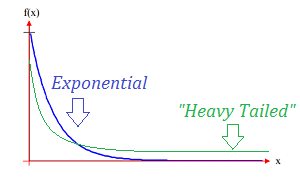
\[\frac{E[x^4]}{E[x^2]^2}.\]So kurtosis is not mainly asking: “How large is the noise”? It is asking: “How heavy are the tails relative to the normal noise scale?”
A Gaussian distribution has kurtosis $3$.
Small numerical example
Consider these residuals:
\[x = {-1,-1,1,1}.\]First compute the second moment:
\[\frac{1+1+1+1}{4}\]Now compute the fourth moment:
\[\frac{1+1+1+1}{4}\]Therefore, Kurtosis is
\[\frac{1}{1^2}\]Now consider a second set:
\[x = {-0.5,-0.5,-0.5,1.5}.\]Its values are more uneven because one value is much larger than the others. The second moment is
\[0.75.\]The fourth moment is
\[1.3125.\]Therefore,
\[\frac{1.3125}{0.75^2} = \frac{1.3125}{0.5625} \approx 2.33.\]So the second distribution has much higher kurtosis:
\[1 \rightarrow 2.33.\]The reason is that the fourth power strongly emphasizes large values.
For example,
\[1.5^2 = 2.25,\]but
\[1.5^4 = 5.0625.\]The larger residual therefore contributes much more strongly to the fourth moment.
Why this matters for synthetic sensor data
Suppose real range residuals occasionally contain large errors, but the synthetic generator mostly produces small Gaussian-like noise.
The generated data might match the real standard deviation:
\[\sigma_{\text{gen}} \approx \sigma_{\text{real}},\]while still producing too few extreme residuals. Kurtosis can detect this difference. A kurtosis-related loss could therefore encourage
\[\text{kurtosis}{\text{gen}} \rightarrow \text{kurtosis}{\text{real}}.\]However, kurtosis uses the fourth power,
\[x^4,\]so very large outliers can dominate it. That makes kurtosis useful for measuring tail behavior, but also potentially sensitive to a small number of extreme samples. This is closely related to using
\[\frac{L_4}{L_2}\]in a differentiable distribution loss. Since
\[\left(E|x|^4\right)^{1/4}\]and
\[\left(E|x|^2\right)^{1/2},\]we have
\[\frac{E|x|^4}{E|x|^2}.\]For a zero-mean residual, this is essentially the kurtosis. So $L_4/L_2$ can be interpreted as a smooth, normalized measure of tail heaviness, closely connected to kurtosis.